The bill that made a bank build its own inference cluster
Most teams discover their AI coding assistant is expensive the same way: someone forwards the monthly invoice to a group chat and nobody wants to reply first. Per-token pricing is invisible during the pilot and brutal at scale. Revolut, the fintech, hit that wall with AI coding tools and did what most companies only talk about in retros: they moved the workload onto their own hardware and open-weight models.
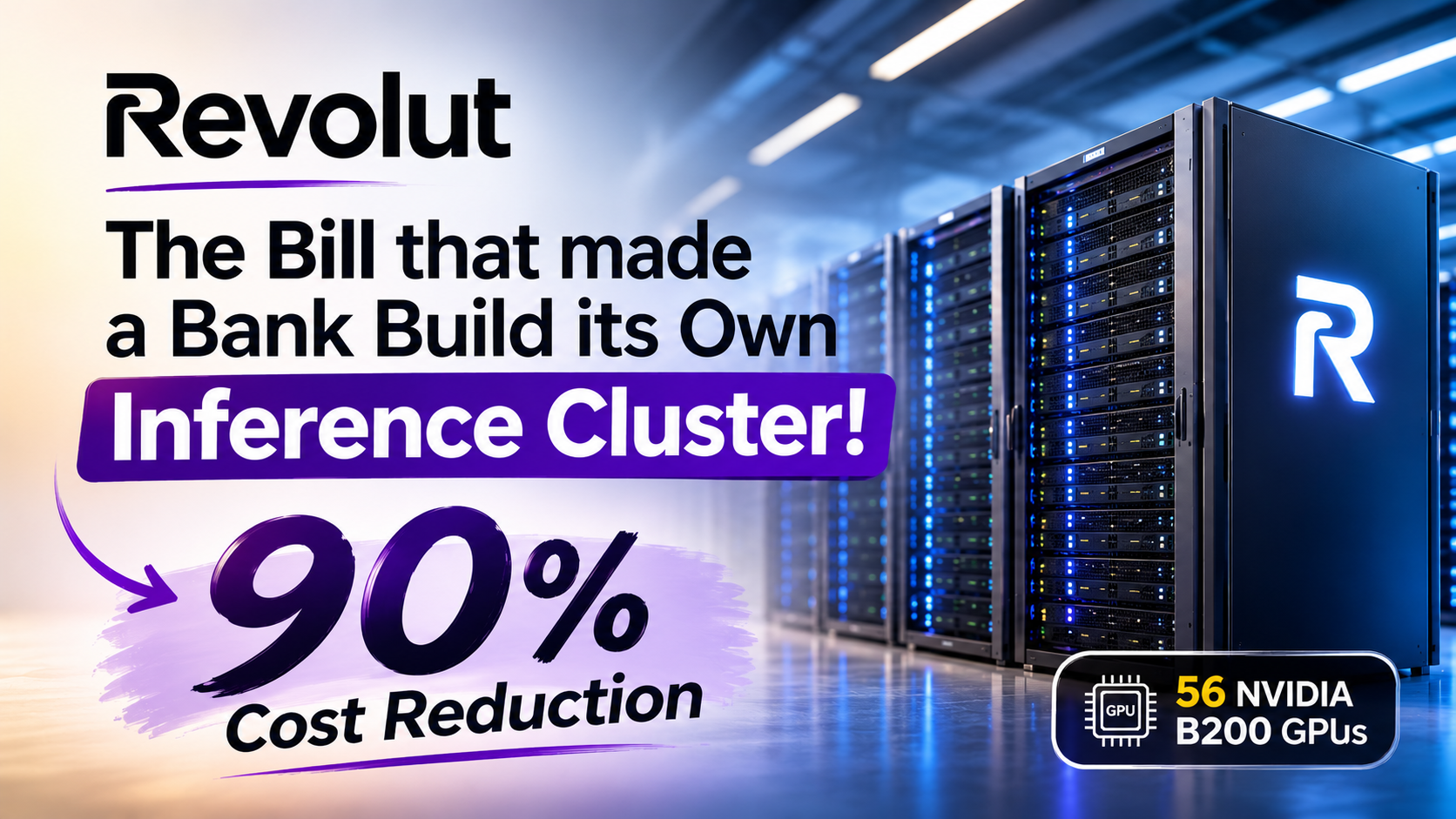
The reported result is a 90% reduction in AI coding costs, achieved by self-hosting the GLM family of open-weight models on 56 NVIDIA B200 GPUs (aiweekly.co). That number is the headline. The useful part is the reasoning behind it, because it tells you when the same move works for you and when it quietly costs you more than the API did.
Why this matters before you look at the mechanics
API pricing is linear. Every completion, every refactor, every agent loop that retries four times because the first three attempts failed adds to the bill. Coding assistants are especially bad here because they are chatty: they read files, propose diffs, get corrected, and try again. Token counts balloon in ways that a demo never shows.
Self-hosted inference flips the cost curve. You pay a large fixed amount for hardware and then a much smaller marginal amount per token. If your usage is high and steady, the fixed cost amortises and the per-token price collapses toward the cost of electricity and depreciation. If your usage is low or spiky, you have bought an expensive space heater.
That is the whole trade. Revolut is on the high-volume side of it. Most individual developers and small teams are not, which is why copying the headline without copying the usage profile is how people lose money.
What Revolut actually did
The setup, as reported, is self-hosted inference of open-weight GLM models on a 56-GPU B200 cluster, replacing paid API access for coding workloads (trendingtopics.eu). Two decisions matter more than the GPU count.
First, open weights. GLM models are downloadable, which means no per-token contract and no vendor deciding your price next quarter. You trade a licence fee for an operations burden.
Second, self-hosting at cluster scale. This is not a workstation under a desk. It is datacentre-class infrastructure with the power, cooling, networking and staffing that implies. The 90% figure is real, but it is a figure that only exists because someone else already paid for the operational maturity.
The numbers, side by side
| Dimension | Per-token API | Self-hosted GLM on 56 B200s |
|---|---|---|
| Cost structure | Linear, per token | Large fixed, near-flat marginal |
| Reported cost change | Baseline | Down ~90% |
| Hardware | None owned | 56 × NVIDIA B200 |
| Ops burden | Vendor | In-house (power, cooling, on-call) |
| Scaling behaviour | Instant, expensive | Step function, capital-intensive |
| Best fit | Low or spiky usage | High, steady, predictable usage |
The table is the article. Everything else is commentary on which column you live in.
The part the headline skips: 56 B200s is not a developer setup
A B200 is a datacentre accelerator. Fifty-six of them is a facility, not a purchase. If you are reading this on a desktop, the Revolut architecture is not a template you can shrink — it is a different category of decision.
What transfers is the method, not the hardware count:
- Measure your actual token spend before you decide anything. Most people guess and guess wrong.
- Identify the workloads that are high-volume and repetitive. Those are the ones worth moving local.
- Keep a hosted API for the long tail. Burst capacity is what APIs are genuinely good at.
- Only then size hardware against the workload that survived the first three steps.
That last step is where most local AI builds go wrong. People buy the card first and discover the workload second. If you are at that stage, the guide on how much VRAM you actually need is the place to start, because model size and context length — not brand loyalty — set the floor.
What a realistic local version looks like
You will not reproduce a 90% cut on a single GPU, and pretending otherwise is dishonest. What you can do is move a meaningful slice of coding work off the meter and onto hardware you own.
A concrete example. Suppose your assistant handles autocomplete, small refactors and test generation — the high-frequency, low-complexity end. Those tasks tolerate a smaller quantised open-weight model well. The hard architectural questions and long-context debugging still go to a hosted frontier model. You have not eliminated the API bill; you have removed the 70–80% of calls that were cheap to serve locally and expensive to bill.
That split is the realistic version of the Revolut play, and it is the one worth building toward. The AI Accelerators category is where the hardware for that split lives, and the guide to choosing between accelerator classes explains why a workstation card and a datacentre card are not interchangeable even when the VRAM numbers match.
A worked comparison for a single developer
| Scenario | Monthly API spend | Local hardware | Break-even |
|---|---|---|---|
| Light use (a few hundred completions/day) | Low | Not justified | Never |
| Heavy use (agent loops, large repos) | High | One workstation GPU | Months, not years |
| Team of 5–10 heavy users | Very high | Shared inference box | Plausible within a year |
The middle row is where most readers of this site sit. The top row is where most people think they sit. Be honest about which one you are.
The cheap option costs you time
This is the sentence the vendor blogs leave out: self-hosting is not free, it is prepaid in labour. You will spend evenings on quantisation choices, context limits, throughput tuning and the inevitable driver update that breaks a working stack. Revolut absorbed that cost with a platform team. You will absorb it with your own evenings.
That is not an argument against doing it. It is an argument for doing it deliberately, on a workload where the savings are large enough to pay for the time. If your API bill is small, self-hosting is a hobby with a hardware receipt. If your API bill is large and growing, the maths flips fast.
There is also a hardware-timing risk. Accelerator prices move with the AI boom, and buying at the wrong moment erodes the savings you were chasing. The piece on GPU prices climbing again covers that dynamic, and it is worth reading before you commit capital.
If you are going to build it, build it balanced
A common failure mode: a fast GPU throttled by an undersized power supply, or a workstation that sounds like a leaf blower and gets moved to a closet where it overheats. The power, cooling and system balance guide exists because this happens constantly. Compute is only one third of a working local inference box.
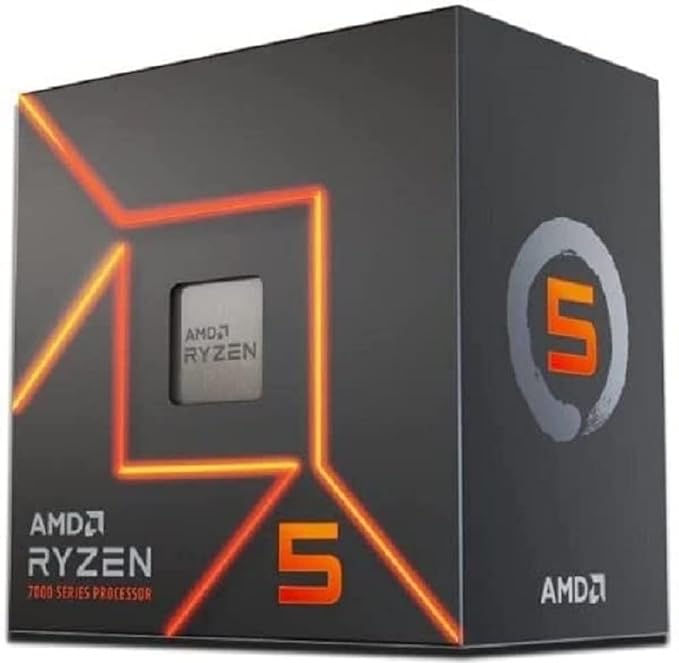
For readers sizing a first serious build, a sensible starting point is a current-generation desktop CPU paired with a workstation-class GPU rather than a gaming card. The AMD Ryzen 5 7600 is a reasonable host CPU for a single-GPU inference box — six cores, AM5 platform, enough headroom to feed the accelerator without becoming the bottleneck. Pair it with a card chosen against your actual model sizes, not the biggest number you can afford.
If you want to see what different VRAM tiers genuinely run before you spend anything, the breakdown of what 8GB to 32GB of VRAM actually runs is a useful reality check. And when you are ready to shortlist, the catalogue shortlisting guide will save you from buying on spec sheet alone.
FAQ
Did Revolut really cut AI coding costs by 90%?
That is the reported figure from coverage of the deployment: self-hosted GLM on 56 B200s, roughly 90% lower cost versus the previous approach. It is an owner's measurement of their own workload, not an independent benchmark, and it should be read that way.
Can a solo developer copy this?
Not the hardware. The method, yes. Measure spend, move high-volume repetitive work to a local open-weight model, keep the API for the hard cases. The percentage you save will be smaller and the break-even longer, but the logic holds.
Are open-weight models good enough for coding?
The GLM family is capable enough that a large financial institution chose it for production coding workloads. That is a meaningful signal. It does not mean every open model matches every frontier model on every task — test against your own codebase.
What is the real risk of self-hosting?
Operational time. Hardware is a one-off purchase; tuning, maintenance and breakage are ongoing. Budget the hours, not just the dollars.
Conclusion
The Revolut story is not "self-hosting is cheaper." It is "self-hosting is cheaper at a certain volume, with a certain team, on a certain workload." The 90% figure is the reward for getting all three right. Get them wrong and you have bought a very expensive lesson in capacity planning.
Start with your invoice, not a GPU. If the invoice justifies the hardware, the rest is engineering. If it does not, the API is still the correct answer, and there is no shame in that.
Sources and verification
- emergent.sh — Revolut cuts AI coding costs 90% with self-hosted models — secondary coverage of the deployment and the 90% figure.
- trendingtopics.eu — Revolut, GLM and open-weight coding costs — coverage of the GLM open-weight choice.
- aiweekly.co — Revolut cuts AI coding costs 90% with self-hosted GLM on 56 B200s — source for the 56 B200 figure.
- YouTube — source video — referenced for context; no extract was available for verification.
What was checked: the 90% cost reduction, the GLM open-weight model choice, and the 56 B200 GPU count, all as reported by the sources above.
What is an owner's measurement: the 90% figure is Revolut's own reported result against their own prior spend. It is not an independent benchmark and no methodology was published in the sources reviewed.
What could not be verified: the exact baseline cost, the specific GLM model variants deployed, throughput and latency numbers, and the total cost of ownership including power, cooling and staffing. Treat the headline as directional, not audited.